Living on Maui comes with a pretty long list of benefits. Salt air, warm temperatures, trade winds, and being close to the ocean are part of what makes living here special.
Unfortunately, your air conditioning system experiences that same environment very differently.
We see AC equipment all over Maui that has to operate in conditions that are much harder on it than what the same equipment might experience on the mainland. Salt in the air can accelerate corrosion. Humidity keeps systems working to remove moisture as well as heat. Depending on where you live, how close you are to the coast, and how often you run your AC, those conditions can shorten the life of a system that isn’t properly maintained.
That doesn’t mean AC equipment can’t last on Maui. It means you need to take our local environment into account when choosing, installing, and maintaining it.
Salt Air Doesn’t Only Affect Homes Right on the Beach
If you own a home or business near the water in Kihei or Lahaina, salt exposure probably isn’t a surprise. You can see what it does to vehicles, railings, outdoor furniture, and just about anything else made of metal.
Your outdoor AC equipment isn’t immune.
Salt particles carried through the air can settle on the condenser coil, cabinet, fasteners, and other metal components. Add moisture to the equation and corrosion can develop much faster than it would in a dry inland climate.
And you don’t have to live directly on the ocean for it to matter. Trade winds can carry salty air well beyond the shoreline, so we see the effects in different parts of Maui, including Kahului.
A little surface corrosion doesn’t necessarily mean your air conditioner is about to fail. The concern is what happens as that exposure continues year after year.
Corrosion can damage coil surfaces, connections, and other components. As the outdoor coil deteriorates or becomes coated with contaminants, the system can have a harder time transferring heat. Eventually, what started as an environmental issue can contribute to reduced performance, refrigerant leaks, or component failure.
Maui’s Humidity Creates a Different Challenge
Salt gets a lot of attention, but humidity is another big part of the equation.
Your air conditioner isn’t only lowering the temperature inside your home or business. As warm, humid air moves across the indoor coil, the system also removes moisture from the air.
That’s part of why properly functioning air conditioning feels so much better than simply moving air around with a fan.
But removing all that moisture creates additional demands on the system. Condensates have to drain properly, coils need to stay clean, airflow needs to remain adequate, and the system needs to be operating correctly.
When something isn’t right, you may start noticing that the building feels cool but still clammy. You might see excess condensation, experience drainage issues, or notice musty odors developing around an indoor unit.
Humidity can also make dirt and other contaminants more difficult to ignore. When coils, filters, or drain systems aren’t being maintained, Maui’s climate has a way of making those problems show themselves.
Your AC May Tell You There’s a Problem Before It Stops Working
One of the biggest mistakes we see is waiting for an air conditioner to completely stop cooling before having it checked.
Most systems give you some warning.
Maybe a room takes longer to cool than it used to. The system seems to run constantly. Your electric bill starts creeping up without an obvious explanation. You notice corrosion around the outdoor unit, water where it shouldn’t be, unusual sounds, or a change in the way the air coming from the system smells.
None of those automatically means you need a new air conditioner.
They do mean it’s worth finding out what’s happening before a smaller problem becomes a much more expensive one.
That’s especially important on Maui because a system that’s already struggling with airflow, dirty coils, or another maintenance issue is still being asked to operate in a hot, humid, and potentially corrosive environment every day.
Our professional AC repair checklist for Maui homes covers several other warning signs worth watching before cooling problems become more serious.
Maintenance Schedules Should Reflect Where and How You Live
There’s no single maintenance schedule that’s right for every property on Maui.
For many residential systems, professional service at least twice a year can be a reasonable starting point. But that’s not a rule that applies equally to everyone.
A heavily used system near the coast may need attention more frequently. So might equipment serving a vacation rental, restaurant, office, retail space, or other commercial property that runs for long periods every day.
The age of the equipment matters too.
That’s why we prefer looking at the actual system and how it’s being used rather than telling every customer that the same maintenance schedule works for every property.
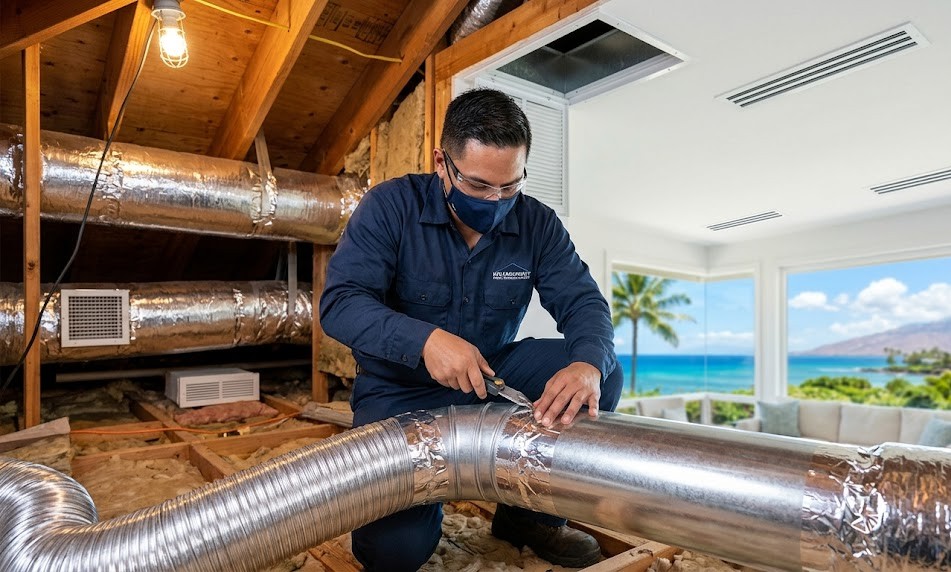
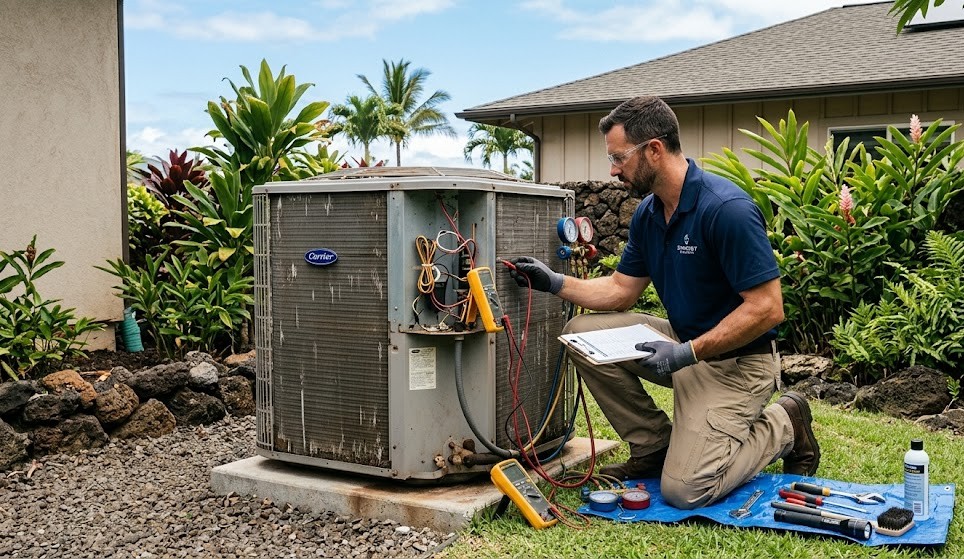
During professional AC maintenance and repair, we’re looking for more than whether the system turns on and blows cold air. Coil condition, drainage, electrical components, airflow, and signs of corrosion all help tell us how the equipment is holding up in Maui’s environment.
The objective isn’t just to prevent today’s breakdown. It’s to catch the things that can reduce efficiency or shorten equipment life over time.
The Equipment You Choose Matters Too
If you’re replacing an older system or installing air conditioning in a new property, coastal conditions should be part of that conversation from the beginning.
Some manufacturers offer equipment with factory-applied coatings and other corrosion-resistant features designed to provide additional protection in coastal environments.
That doesn’t make any system maintenance-free. Salt air eventually finds its way onto just about everything here.
But equipment selection, proper installation, and thoughtful placement of the outdoor unit can all make a difference.
This is one reason we don’t believe choosing an AC system should come down to looking at a model number or comparing efficiency ratings online. The right system also needs to fit the property, the way you intend to use it, and the environment where it will be operating.
Synairgy provides AC installation services and ductless mini-split systems for homes and businesses across Maui. The goal is to help determine what makes sense before the equipment is installed, not after problems start showing up.
Don’t Forget About the Outdoor Unit
The outdoor condenser sometimes becomes the forgotten half of an AC system.
The indoor unit is easy to notice because you see and hear it every day. The condenser may be around the side of the house, behind the building, or sitting somewhere you rarely visit.
On Maui, it’s worth taking a look at it occasionally.
Heavy vegetation and debris can interfere with airflow. Visible salt buildup or increasing corrosion can be a sign that the equipment needs attention.
If you’re rinsing an outdoor unit as part of manufacturer-approved care, use gentle water pressure. High-pressure washing can damage the delicate coil fins and create a different problem.
More importantly, rinsing the outside of a condenser isn’t a substitute for professional maintenance. Some of the most important signs of deterioration aren’t obvious from looking at the cabinet.
Commercial Systems Can Need Even More Attention
The same environmental conditions affect businesses, but commercial AC equipment often has another factor working against it: operating time.
A home system may cycle on and off depending on when people are home. A restaurant, retail space, office, condo property, or other commercial facility may depend on cooling for much longer periods every day.
More operating hours mean more wear.
Combine that with salt exposure and humidity and it’s easy to see why a commercial property may require a different maintenance schedule than a typical residence.
For a business owner or property manager, preventive maintenance also isn’t only about equipment life. An unexpected AC failure can affect employees, customers, tenants, and normal business operations.
That’s why commercial HVAC maintenance and repair should be based on equipment usage and property conditions rather than a one-size-fits-all schedule.
Can You Completely Prevent Salt-Air Corrosion?
Probably not.
If outdoor equipment is exposed to Maui’s environment long enough, some degree of weathering is going to happen. The more useful question is whether you can slow the process and catch problems before they become failures.
In many cases, you can.
Choosing appropriate equipment, installing it correctly, keeping coils and components clean, maintaining good airflow, and inspecting the system regularly can all help extend its useful life.
What maintenance can’t do is reverse corrosion that’s already seriously damaged a coil or component. That’s why catching deterioration early matters.
When Is Corrosion Bad Enough to Replace an AC System?
There’s no universal amount of visible rust that means an AC system needs to be replaced.
We look at the condition of the entire system.
How old is it? Is it still cooling properly? Are refrigerant leaks developing? Are repairs becoming more frequent? How extensive is the corrosion? Are replacement parts readily available? And at what point are you putting good money into equipment that’s nearing the end of its useful life?
Sometimes the right answer is maintenance or repair. Sometimes replacement makes more financial sense.
A good HVAC contractor should be able to explain the difference and give you enough information to make that decision without pressuring you into equipment you don’t need.
Protecting Your AC Investment on Maui
Air conditioning equipment is a significant investment, and Maui can be a tough place for that equipment to live.
Our team works with AC systems across the island every day, so we understand that maintaining equipment here requires taking Maui’s climate and individual property conditions into account.
If you’re seeing corrosion, reduced cooling, unusual moisture, rising energy use, or you simply don’t know when your system was last thoroughly inspected, we’re happy to take a look.
Synairgy provides AC maintenance, repair, and installation for homes and businesses throughout Maui, including Kahului, Kihei, Wailuku, Lahaina, and surrounding communities.
Contact Synairgy to schedule service and make sure your AC system is ready for the conditions it faces every day.
Questions We Hear From Maui Property Owners
Does salt air really make AC systems wear out faster on Maui?
Yes. Salt carried through the air can settle on outdoor coils, cabinets, electrical connections, and other metal components. Combined with moisture and regular use, that can accelerate corrosion and eventually affect system performance or contribute to component failure.
The amount of exposure varies by location. Properties close to the coast may experience particularly aggressive conditions, while trade winds can carry salt and other contaminants farther inland as well.
How often should an AC system be serviced on Maui?
For many Maui homes, professional AC maintenance at least twice a year is a reasonable starting point. Some systems need more attention.
A coastal property, heavily used system, vacation rental, restaurant, office, or other commercial property may benefit from more frequent service based on operating hours, equipment condition, and environmental exposure.
The better question isn’t simply how many months have passed. It’s how hard the equipment is working and what conditions it’s operating in.
Should I rinse the outdoor AC unit to remove salt?
Keeping salt and debris from accumulating on the outdoor unit can help, but it needs to be done carefully and according to the equipment manufacturer’s recommendations.
Gentle rinsing may be appropriate for some equipment. High-pressure washing isn’t. Condenser fins are delicate, and damaging them can restrict airflow and create a new problem.
Cleaning the outside of the unit also doesn’t replace professional maintenance since corrosion and other problems may be developing in areas you can’t easily see.
Can an AC system with corrosion be repaired?
Sometimes.
Surface corrosion doesn’t automatically mean an air conditioner needs to be replaced. We look at where the corrosion is occurring, how extensive it is, the age and overall condition of the system, whether refrigerant leaks or other failures are developing, and the expected cost of keeping the equipment operating.
If you’re noticing corrosion along with weaker cooling, unusual noises, higher electricity use, or other changes in performance, it’s worth having the system evaluated before deciding whether repair or replacement makes sense.
Does Maui’s humidity affect how an air conditioner operates?
Absolutely. Your AC isn’t only cooling the air. It’s also removing moisture from it.
High humidity means drainage, airflow, coils, filters, and system sizing all become especially important. When something isn’t working correctly, you may notice that the space feels cool but still humid, condensation develops where it shouldn’t, or musty odors begin appearing.
Humidity can affect comfort and indoor air quality as well as the equipment itself. We’ve covered those issues in more detail in our guide to indoor air quality in Maui.
Is there AC equipment that’s better suited for Maui’s coastal environment?
Equipment choice can make a difference, but there isn’t one system that’s automatically right for every Maui property.
The type of property, cooling load, installation location, salt exposure, how frequently the system will run, serviceability, efficiency, and budget all matter. Some equipment also includes additional corrosion-resistant features that can be useful in coastal conditions.
That’s why we recommend evaluating the property before choosing equipment. The objective is to find the system and installation approach that make sense for how and where the equipment will actually be used.