Why Your Maui AC May Be Working Harder Than It Should
After months of warm Maui weather, your air conditioning system has been putting in plenty of hours. By late summer and early fall, you may start noticing small changes.
The AC runs a little longer. One room doesn’t feel quite as comfortable. Airflow seems weaker, or your electric bill has crept upward.
Those changes don’t necessarily mean your AC is failing. But they can be signs that the system is working harder than it should.
Maui’s heat, humidity, salt air and long cooling season can all take a toll over time. Paying attention to the smaller warning signs can help you address a problem before it turns into a larger and potentially more expensive one.
Longer Run Times Don’t Always Mean Your AC Is Failing
On a hot Maui afternoon, your air conditioner is naturally going to run more than it would on a cooler day. That’s normal.
What’s worth paying attention to is a change from what’s normal for your home.
If the system suddenly seems to run much longer, struggles to reach the thermostat setting, cycles differently than it used to, or doesn’t cool the house evenly, something may be reducing its efficiency.
That doesn’t automatically mean you need a new system.
It may be something relatively straightforward, such as restricted airflow, a dirty coil or a maintenance issue. The important thing is figuring out what’s happening before assuming the worst.
Airflow Problems Can Make the Entire System Work Harder
An air conditioner needs to move air efficiently through the system and throughout your home.
A dirty filter is one of the simplest things that can interfere with that process, but it’s not the only possibility. Blocked vents, dirty components, duct problems and other airflow restrictions can all make the system work harder to maintain the temperature you’re asking for.
You may notice certain rooms aren’t as comfortable as others, airflow from the vents seems weaker, or the system stays on longer than it used to.
That’s why it’s important to look at the overall system rather than simply focusing on whether cold air is coming out of a vent.
Maui’s Outdoor Conditions Matter Too
We recently talked about the effect Maui’s salt air and humidity can have on AC equipment, and it’s worth emphasizing because those conditions don’t only affect the appearance of an outdoor unit.
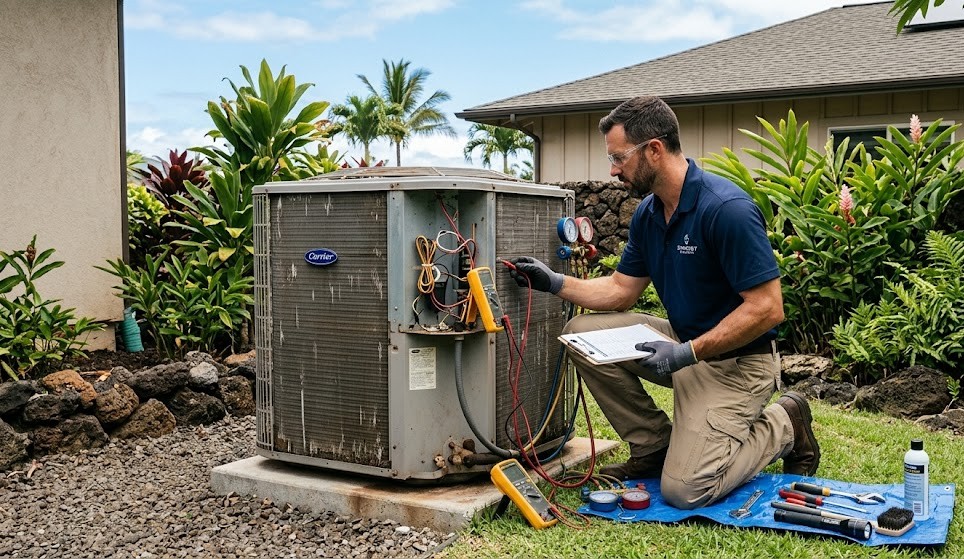
Salt, moisture and contaminants can build up on components and contribute to corrosion and reduced heat transfer. When an outdoor unit can’t release heat efficiently, the entire system may have to work harder.
Homes closer to the ocean can face particularly challenging conditions, but even properties farther inland aren’t completely removed from Maui’s humid, salty environment.
Regular inspection and appropriate maintenance can help identify deterioration before it turns into a larger problem. For more on Maui’s unique environment, read How Maui’s Salt Air & Humidity Affect Your AC System.
Maintenance Matters When Your AC Gets Used So Much
One of the realities of air conditioning on Maui is that many systems don’t get much of a break.
Unlike climates where AC equipment may sit unused for several months, Maui systems can accumulate significant operating hours throughout the year.
More operating hours mean more opportunity for filters to become dirty, coils to collect debris and components to wear.
That’s one reason we don’t believe AC maintenance should automatically be treated as a once-or-twice-a-year checkbox. The right schedule depends on the equipment, the property, its location and how heavily the system is being used.
For some Maui homes, particularly those exposed to harsher coastal conditions or heavy AC use, more frequent attention can make sense.
The goal isn’t to perform maintenance just for the sake of maintenance. It’s to keep the equipment operating properly and identify developing problems while they’re still manageable.
Your Ductwork May Be Part of the Problem
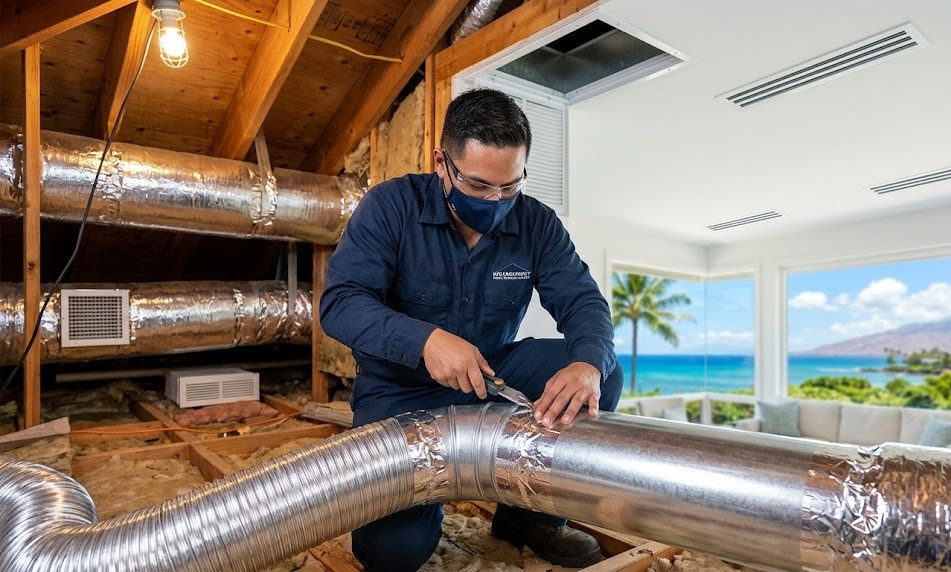
Sometimes the AC equipment itself is doing exactly what it’s supposed to do, but the conditioned air isn’t getting where it needs to go efficiently.
Ductwork can have a major effect on comfort and system performance.
Leaks, restrictions, poor connections or other duct issues can contribute to uneven temperatures and longer run times. The system may keep operating because the thermostat is calling for more cooling even though some of the conditioned air isn’t being delivered effectively.
If you’ve always had a room that seems hotter than the rest of the house, that’s worth investigating rather than simply accepting it as “the hot room.”
The problem may not be the AC unit at all.
The System May Not Be the Right Fit for the Home
Bigger isn’t automatically better when it comes to air conditioning.
An AC system needs to be properly matched to the home, its layout and the cooling demand. An improperly sized system can create comfort, humidity and efficiency problems even if the equipment itself is relatively new.
The same issue can arise when a home changes.
Maybe an addition was built, rooms were remodeled, windows were replaced or the way the space is being used has changed. What worked well years ago may not necessarily be the best match today.
That’s why replacing an AC system shouldn’t simply mean looking at the label on the old equipment and installing another one exactly like it.
A good installation starts with understanding the property.
A Higher Electric Bill Can Be a Clue
Electricity costs can change for plenty of reasons, so a higher bill by itself doesn’t prove there’s an AC problem.
But if your usage patterns haven’t changed significantly and the system seems to be running more often, it’s worth paying attention.
An air conditioner that has to operate longer to provide the same amount of cooling is using more energy to do the job.
That could point toward maintenance needs, airflow restrictions, deteriorating components, duct issues or an aging system that’s simply losing efficiency.
Looking at those symptoms together usually tells you more than looking at any one of them by itself.
Repair or Replace? Start With the Diagnosis
One of the most common questions homeowners have is whether it’s still worth repairing an older AC system.
There’s no universal answer.
Age matters, but so do the condition of the equipment, the nature of the repair, efficiency, maintenance history and whether the system is still appropriate for the home.
Our preference is to start with the diagnosis.
If a practical repair can keep a system operating reliably, that’s a very different conversation from a system experiencing repeated failures or requiring a major investment near the end of its useful life.
Homeowners deserve enough information to understand their options and make the decision that makes sense for their home and budget.
What Maui Homeowners Often Want to Know
Why does my AC seem to run all the time?
Hot weather can naturally increase run time, but unusually long operation can also be related to restricted airflow, dirty components, duct issues, equipment condition, thermostat settings or a system that’s struggling to meet the home’s cooling demand.
Does living near the ocean affect my AC?
It can. Salt and moisture can accelerate corrosion and affect outdoor equipment. Properties closer to the coastline may require additional attention, but salt air and humidity are factors throughout Maui.
How often should an AC system be maintained in Maui?
There isn’t one schedule that’s right for every property. Usage, equipment type, location and environmental exposure all matter. Systems operating heavily or in harsher coastal conditions may benefit from more frequent attention.
Does a high electric bill mean I need a new AC?
Not necessarily. A change in energy use can have several causes. If the increase coincides with longer AC run times or reduced comfort, having the system evaluated can help determine whether maintenance, repair or equipment efficiency is contributing.
How do I know whether to repair or replace my AC?
Start with the condition of the existing system rather than its age alone. The repair needed, overall equipment condition, efficiency, reliability and cost of keeping the system operating should all be part of the decision.
After a Long Maui Summer, Pay Attention to What Your AC Is Telling You
As Maui moves from summer into fall, your AC isn’t necessarily heading into retirement for the season. But it has just come through months of regular use, which makes this a good time to pay attention to how it’s performing.
Most AC problems don’t begin with a system that suddenly stops working.
Often there are smaller signs first: longer run times, weaker airflow, uneven cooling, unusual sounds, more frequent service needs or an unexplained change in energy use.
Catching those signs early gives you more options.
At Synairgy Mechanical, our goal is to help Maui homeowners understand what’s happening with their system and what makes sense to do about it. Sometimes that’s maintenance. Sometimes it’s a repair. Eventually, every system reaches the point where replacement makes more sense.
The first step is getting the right diagnosis.
If your AC isn’t cooling the way it used to or seems to be working harder to keep your home comfortable, contact Synairgy Mechanical to schedule an evaluation.